
In 1942, Philip Wylie, a social critic now almost forgotten except to historians, set forth some extremely acidulous observations (some might call them a diatribe), about a new sort of disease that he called "momism". Like every other "ism" in the book, this one’s perniciousness was apparent, but only if one cared to remove certain psychological blinders. "Momism" might best be described as the disease contracted by married women with too much time on their hands and insufficient common sense. More simply, it was the accusation, directed by Wylie at a group of contemporary mothers, that they were living through their children to a degree that was, to say the least, obsessive. Under the guise of caring for their children, these mothers would attempt to run (and ruin) their children’s lives. Their technique was so stealthy that the children would have a difficult time mustering up sufficient evidence to prove any case. This paradox of malevolent maternal nurturing is now seized upon by feminist historians as a justification for the so-called "repressive" domestic-angel model of 1950s womanhood (the twin shocks of economic depression and war, followed by an urge toward normality at any price being the initial trigger).

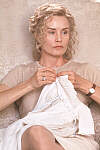
Perhaps it should be suggested that Wylie’s model was only half-forgotten. In the new film, Hush, the audience is treated to the logical outcome of Wylie’s Exhibit "A" of motherhood run amok. Meet Martha Baring (Lange), a woman of means who owns and operates Kiloran, her very own little horse-breeding farm (which looks suspiciously like a slightly smaller version of Jefferson’s Monticello). The Widder Baring has a son, Jackson (Schaech), who is, to say the least, the apple of his mother’s ever-attentive eye. Unfortunately, maturity and hormones have conspired to place a worm in Martha’s paradise: her son has fallen in love with Helen (Paltrow), an attractive young woman with no past at all (her parents died when she was very young). By contrast, and befitting a prosperous Southern family, the Baring family possesses the requisite scandal that never quite manages to stay buried. It seems that Papa Baring died when Jackson was seven, under fairly mysterious circumstances, leaving the young man to his mother’s smothering care. His escape to New York, and his love for Helen, is a little more than Mom can tolerate, especially since Sonny refuses to do his duty and come back to run the family business.
Fortunately for Martha, a series of conveniently-timed events (Helen’s unforeseen pregnancy, a nasty assault upon her in the couple’s apartment, and her marriage to Jackson,) brings the young couple back into Martha’s sphere of influence. But, soon, under the influence of Jackson’s grandmother, Alice Baring (Foch), Helen begins to suspect that the molasses-thick charm displayed by Martha has a consistency similar to that of Krazy Glue. Martha begins by disrupting the intimacy between husband and wife, and moves on to more overt threats against her daughter-in-law. Being the considerate soul that she is, Martha even offers Helen a nice, surreptitiously-administered dose of oxytocin to hasten the arrival of a grandchild into the world, and threatens to offer Helen far more.
Upon seeing Hush, the first temptation that comes to mind is to relate the
ridiculously-scripted antics and hilariously-overheated melodramatic atmosphere within to
a fifth-rate version of a Tennessee Williams play, because both Hushand most of
Williams’ best-known works, such as Cat on a Hot Tin Roof , offer up common
elements, most notably the Southern family on the verge of disintegration with the mad
matriarch, or would-be matriarch, at its helm (indeed, Lange, having played Maggie the Cat
on Broadway and for television, is intimately acquainted with this sort of desperate,
rebellious woman on the edge who is trapped within conventions and has everything and
nothing to lose all at once).  But Hushdoesn’t have the emotional complexity that raises a
Williams play above its hyperbolic plot mechanics, an obvious fault that first-time
director and co-writer Darby should have realized from the start. As with the latest
remake of Great Expectations, we are instead back in the realm of Robert
Aldrich’s 1960s psychodramas (Whatever Happened to Baby Jane?, Hush, Hush,
Sweet Charlotte) where refugees from the then-recently defunct studio system, such as
Crawford and Davis, could rework their old on-screen personas for all they were worth
until they were so wrung out from overuse that they descended into camp. You could take
the performances straight, if you so desired, but there was so little depth contained
therein that the real entertainment came from surveying them from an extra-textual
perspective. There was something perversely thrilling about watching Charlotte, for
example, and seeing the once-almighty Davis in a state of utter psychological disrepair
(akin to watching a car wreck), after having been worked over by villains Joseph Cotten
and Olivia De Havilland (in fact, the horrific birthing sequence in Hush shares
more than a few common elements with a similar scene in Charlotte, in which De
Havilland, having worked her final act of outrage upon the mentally-fragile Charlotte,
commences to "soothe" her victim with a nasty sneer on her face).
But Hushdoesn’t have the emotional complexity that raises a
Williams play above its hyperbolic plot mechanics, an obvious fault that first-time
director and co-writer Darby should have realized from the start. As with the latest
remake of Great Expectations, we are instead back in the realm of Robert
Aldrich’s 1960s psychodramas (Whatever Happened to Baby Jane?, Hush, Hush,
Sweet Charlotte) where refugees from the then-recently defunct studio system, such as
Crawford and Davis, could rework their old on-screen personas for all they were worth
until they were so wrung out from overuse that they descended into camp. You could take
the performances straight, if you so desired, but there was so little depth contained
therein that the real entertainment came from surveying them from an extra-textual
perspective. There was something perversely thrilling about watching Charlotte, for
example, and seeing the once-almighty Davis in a state of utter psychological disrepair
(akin to watching a car wreck), after having been worked over by villains Joseph Cotten
and Olivia De Havilland (in fact, the horrific birthing sequence in Hush shares
more than a few common elements with a similar scene in Charlotte, in which De
Havilland, having worked her final act of outrage upon the mentally-fragile Charlotte,
commences to "soothe" her victim with a nasty sneer on her face).
So it is with Hush. You don’t watch this film to obtain deeper insight into
dysfunctional parenting, and you don’t do so in order to observe the chemistry
between Paltrow and Schaech, because there isn’t any worth mentioning; in fact, their relationship
is the most dishonest aspect of the entire film, lacking as it does any real semblance of
passion (the conception of Helen and Jackson’s child had to have been of the
immaculate variety, for all of the sexual gymnastics they are obliged to undertake to
impress upon their audience how much in love they are) No, you go to this film in order to
watch the wonderfully-choreographed catfight between old pros Foch and Lange, and to watch
Lange perform a most glorious act of self-immolation upon her old, serious roles, such as
her Oscar-nominated turn as Frances Farmer in 1982. Lange puts her foot upon that
performance and pulls it inside out for this film, turning the victimizer-as-victim into
the victim-as-victimizer in the process.
because there isn’t any worth mentioning; in fact, their relationship
is the most dishonest aspect of the entire film, lacking as it does any real semblance of
passion (the conception of Helen and Jackson’s child had to have been of the
immaculate variety, for all of the sexual gymnastics they are obliged to undertake to
impress upon their audience how much in love they are) No, you go to this film in order to
watch the wonderfully-choreographed catfight between old pros Foch and Lange, and to watch
Lange perform a most glorious act of self-immolation upon her old, serious roles, such as
her Oscar-nominated turn as Frances Farmer in 1982. Lange puts her foot upon that
performance and pulls it inside out for this film, turning the victimizer-as-victim into
the victim-as-victimizer in the process.
Yet, for all of her character’s vicious tendencies, Lange is careful not to let
the role lead her too far off the edge of sanity too soon. She doles out the
ever-revelatory clues to her character with the skill of a Vegas blackjack dealer, and
just often enough to keep the film from descending completely into the realm of the
moribund. Lange skillfully integrates the overblown aspects of Martha’s
characterization with her obsessive regard for her Catholic faith and turns the
combination into a mad, emotional light show (although many devout Catholics will probably
not appreciate the film’s treatment of their religion as a quasi-mystical refuge for
the emotionally disturbed). 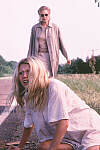 She is also ably assisted by some of the most God-awful, unintentionally
funny dialogue written for a film scenario of late (a dubious achievement in at least
several seasons of bad movie dialogue). When Martha tells Helen , with a tenderly sinister
hiss in her voice, that she must bring a child into the world without benefit of
painkillers, so that Helen will know what loving a child really means, thereby making
herself the update to the Genesis command that Eve must bring forth her children in pain
and sorrow as punishment for her crimes, the audience sees Martha completely unhinged. As
this most bitchy of domestic deities, Lange saves everything for the final showdown, which
lacks any semblance of logic and/or credibility, but does wonders for the entertainment
factor (even Paltrow finally gets into the action and raises the ante). The old joke about
Mother being able to take your life because she gave you life hasn’t had this sort of
shamelessly self-conscious and sardonic manifestation in a long time. Unfortunately, this
inability to play things in a convincingly-straight manner will probably condemn Hush
to a short release life, but it has great potential to become an after-market cult
classic.
She is also ably assisted by some of the most God-awful, unintentionally
funny dialogue written for a film scenario of late (a dubious achievement in at least
several seasons of bad movie dialogue). When Martha tells Helen , with a tenderly sinister
hiss in her voice, that she must bring a child into the world without benefit of
painkillers, so that Helen will know what loving a child really means, thereby making
herself the update to the Genesis command that Eve must bring forth her children in pain
and sorrow as punishment for her crimes, the audience sees Martha completely unhinged. As
this most bitchy of domestic deities, Lange saves everything for the final showdown, which
lacks any semblance of logic and/or credibility, but does wonders for the entertainment
factor (even Paltrow finally gets into the action and raises the ante). The old joke about
Mother being able to take your life because she gave you life hasn’t had this sort of
shamelessly self-conscious and sardonic manifestation in a long time. Unfortunately, this
inability to play things in a convincingly-straight manner will probably condemn Hush
to a short release life, but it has great potential to become an after-market cult
classic.