
In general, it appears to be an unwritten rule that the genesis of comic-book characters has to involve some form of violent catalyst to inspire the super-hero (or heroine). Superman suffered exile, Batman’s parents died at the hands of a thug during a robbery, and the list could go on ad infinitum. Would it hardly be surprising to note how much greater the violence quotient is for cult comic figures?
Take the example of Todd McFarlane’s Spawn, in actuality a government
assassin named Al Simmons (Jai White), who is tired of killing and wants to go straight.
Simmons’ plans run afoul of the foul plans of his supervisor, Jason Wynn (Sheen). 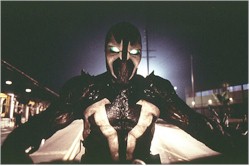 Wynn is on the trajectory
so common to evil megalomanicas: namely, world domination through world annihilation, and
he has, in good Faustian tradition, sold his soul to the devil in order to get it..
Simmons is in his way and is promptly, if gruesomely, dispatched to hell, where he gets an
offer to lead another form of Armageddon. He agrees to do so in exchange for the chance to
see his wife (Randle) one more time. To prepare him for his quest, Simmons, now
transformed into the third-degree-burn survivor called Spawn, is equipped with various
secret devices and super powers. He is also provided with that other stock device: the
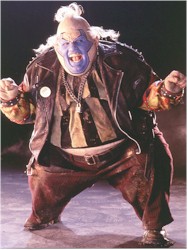
Manichean choice, as two father-figures from both ends of the morality spectrum – the
sinister, mordantly witty, Clown (Leguizamo) and the noble Cogliostro (Williamson) –
fight to control what is left of his conscience.
Wynn is on the trajectory
so common to evil megalomanicas: namely, world domination through world annihilation, and
he has, in good Faustian tradition, sold his soul to the devil in order to get it..
Simmons is in his way and is promptly, if gruesomely, dispatched to hell, where he gets an
offer to lead another form of Armageddon. He agrees to do so in exchange for the chance to
see his wife (Randle) one more time. To prepare him for his quest, Simmons, now
transformed into the third-degree-burn survivor called Spawn, is equipped with various
secret devices and super powers. He is also provided with that other stock device: the
Manichean choice, as two father-figures from both ends of the morality spectrum – the
sinister, mordantly witty, Clown (Leguizamo) and the noble Cogliostro (Williamson) –
fight to control what is left of his conscience.
To recount: we have now been given a superhero whose impetus for behavior stems from
violence, deceit at the hands of a two-faced superior, the bestowing of unique superpowers
on the hero, and the struggle between good and evil. Everything seems to be present and
accounted for. 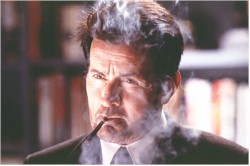 Mentioning
anything else about the narrative would be to reveal too much, except to add that there
are several deliriously deft twists which maintain the narrative tension at an
entertaining level, in spite of the need for long expository passages to establish the
characters and their motivations; there’s even a dollop or two of tension to be wrung
from the self-conscious in-jokes that dot the film’s landscape, as the audience waits
for the punch line to hit it square in the face (one of the funniest jokes – because
so shameless – involves Sheen and the title of his best-known film). The film’s
dark tone is on unabashed display and comes closest in style to Tim Burton’s work on
the original Batman. In fact, Spawn is the nightmarish, pulp-level
meditation on internal turmoil that Batman should have and could have been, had Batman’s
tone not been softened by Michael Keaton’s rather diffident performance in the title
role. Granted, Spawn also contains enough gut-wrenching violence to render it
perhaps a little too extreme for mainstream audiences, but at least audiences in step with
McFarlane’s outrageous vision won’t feel that they have gotten the cinematic
equivalent of the Emperor and his new clothes.
Mentioning
anything else about the narrative would be to reveal too much, except to add that there
are several deliriously deft twists which maintain the narrative tension at an
entertaining level, in spite of the need for long expository passages to establish the
characters and their motivations; there’s even a dollop or two of tension to be wrung
from the self-conscious in-jokes that dot the film’s landscape, as the audience waits
for the punch line to hit it square in the face (one of the funniest jokes – because
so shameless – involves Sheen and the title of his best-known film). The film’s
dark tone is on unabashed display and comes closest in style to Tim Burton’s work on
the original Batman. In fact, Spawn is the nightmarish, pulp-level
meditation on internal turmoil that Batman should have and could have been, had Batman’s
tone not been softened by Michael Keaton’s rather diffident performance in the title
role. Granted, Spawn also contains enough gut-wrenching violence to render it
perhaps a little too extreme for mainstream audiences, but at least audiences in step with
McFarlane’s outrageous vision won’t feel that they have gotten the cinematic
equivalent of the Emperor and his new clothes.
 Oh, by the way, I
should mention that the film version of Spawn also has a strong pedigree in two
other respects: the creative team behind the film are all Industrial Light and Magic
alumni (and the film benefits from some truly creative special effects, courtesy of ILM,
among others). The stunning opening credits set a laudably high technical standard, and
the film never flags in its maintenance (what else would you expect from Lucas and Co.?). Spawn
also has actors who are taking their roles seriously instead of relying upon the special
effects as an excuse for thespian slumming (in particular, Leguizamo – Mr.
"Mambo Mouth" himself – is especially exquisite in his scatological
exploits, and Martin Sheen hasn’t been this powerful on screen, and as terrifying,
since The Dead Zone). Although Spawnmay mine limited territory, it does it
so very well that it is deserving of action films of the summer.
Oh, by the way, I
should mention that the film version of Spawn also has a strong pedigree in two
other respects: the creative team behind the film are all Industrial Light and Magic
alumni (and the film benefits from some truly creative special effects, courtesy of ILM,
among others). The stunning opening credits set a laudably high technical standard, and
the film never flags in its maintenance (what else would you expect from Lucas and Co.?). Spawn
also has actors who are taking their roles seriously instead of relying upon the special
effects as an excuse for thespian slumming (in particular, Leguizamo – Mr.
"Mambo Mouth" himself – is especially exquisite in his scatological
exploits, and Martin Sheen hasn’t been this powerful on screen, and as terrifying,
since The Dead Zone). Although Spawnmay mine limited territory, it does it
so very well that it is deserving of action films of the summer.