
The Ice Storm, in film and book form, captures brilliantly the corrosive, anti-personal responsibility, anti-child mentality, a cultural leftover from the 1960s that worked so well for hedonistic, uncommitted youth, but which didn’t translate so well into middle-class life, with all of its attendant responsibilities (even Strauss and Howe, whose book, Generations, heaped mountains of praise upon the so-called superior nature of their own Boomer cohort, were forced to acknowledge the malevolent effects of their more hedonistic viewpoints upon younger generations stranded in the Boomer wake). The resentment this mentality generated in professionals in their late thirties, still young enough to play and angry at having missed the first wave of what looked like fun, was a particularly poisonous strain, undermining not only parental authority but their children’s sense of trust in their parents to protect and guide them. Ironically, for all of the much-touted benefits of this type of "self-discovery," their tangible manifestation is fairly minimal; Ben Hood, in a car ride home from the train station with his son, still cannot discuss sexuality in an open fashion with him even though Ben is indulging in the covert edition of "open marriage" (adultery in prettier packaging – courtesy of the O’Neills and their fraudulent tome of the same name). Anyone who was unfortunate enough to be raised in this period knows it all too well as an era in which family life threatened to go to pieces at any moment, or, even if he/she was personally sheltered from the misery, knew of someone who was experiencing it first hand. If nothing else, the era, as portrayed in The Ice Storm, aptly demonstrated the sardonic maxim that the middle and upper-middle classes simply couldn’t do the upper-class lifestyle of habitual adultery very well, since they had neither the large amounts of money or lack of responsibility to carry it off with style, not to mention the servants that sheltered the children from its worst effects. This is not to suggest that Lee and Moody aren’t sympathetic on some level with the aspirations of their characters; simply, they have allowed the means to their goals to become the goals themselves, and it is this central error that plays havoc with their, and their children’s, lives. The resulting combination of pity and contempt that Lee and Schamus infuse into their version of The Ice Storm is a perfect one; it ensures empathy with the adults’ plight, while also securing the right amount of detachment with which to judge their behavior.
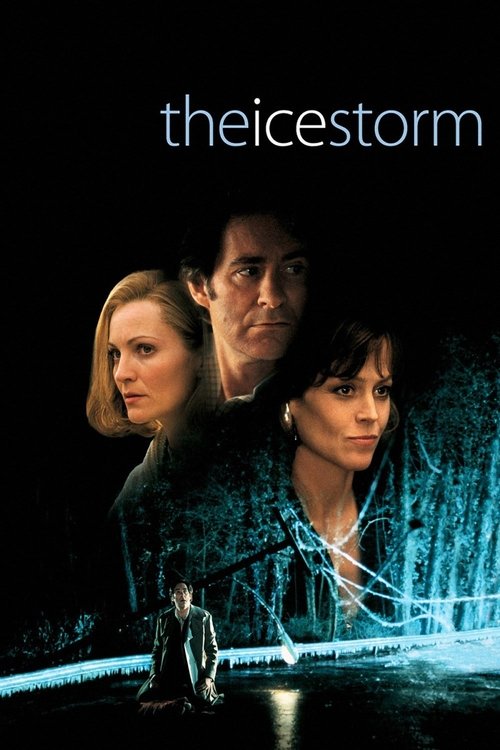

The only problem with the film, under the circumstances, is its ability to find an audience that will appreciate its merits: it isn’t a nostalgia piece, except for the hopelessly misguided or delusional, so that leaves only the childhood survivors, who may or may not be thrilled to have their own worst suspicions about the era laid bare in such chilling detail. Any such perceptional polarization would be unfortunate, for The Ice Storm embodies the oft-quoted, but often never attained, concept of a flawless ensemble cast..
The performances are masterful in their evocation of the internal confusion so common in this period, as middle-class people desperately sought to throw off old conventions while simultaneously being uncomfortable with the process of doing so. Klein and Allen, as the disintegrating centers of this atomic world, give this film its inner strength. Both Ben and Elena are in pain; they know it and, thanks to the actors’ talent, we feel it. Weaver gives one of the best performances of her career as an adulteress wrapped up in her own personal hell of sexual insecurites; she wants her freedom, verification that she’s still attractive and that great van der Rohe sofa in the living room simultaneously, and thinks she’s found the way to have it both ways. Cruelly, she is the only one who isn’t aware of her own ruse – yet. Maguire and Ricci give all of the adult actors a run and a half for their money; they mix bravado and insecurity into a screen presence that is eerie in its accuracy.
The use of pathetic fallacy (literal storm reflecting metaphorical storm), usually so insufferably obvious, works brilliantly within the story’s strict parameters. When the storm arrives, and the inevitable tragedies ensue, it awakens the adult participants to the belated realization of what they’ve done, or tried to do. For some of them, it may be too late for a mid-course correction in their plans. It’s not necessarily true that social experimentation leads to destruction, but the unthinking brand of it most certainly does. This is the central message – and the strength – of The Ice Storm.