
Welcome to Gattaca, a land in the "not-too-distant" future where discrimination is "down to a science," or perhaps attributed just to science itself. It’s a world where your resume is "in your genes", where social winners and social losers are determined not by popularity, but by your genetic code. In this world, "natural" childbirth means getting the right pre-natal mixture of DNA and behavioral traits; it’s called giving the child "the best possible start," but it really means condemning those born without genetic intervention (the so-called "invalids") to a life as servants to those above.

Jerome Morrow (Hawke) is, thankfully for him, one of those blessed with genetic superiority, and part of an even smaller subset of the privileged: he is an astronaut, about to take off on a mission to Titan, a feat that is possible once every seventy years. Needless to say, Morrow also bears a remarkable resemblance to your average dream date: handsome, height-weight proportional, as the personal ads call it, considerate, and a man of means. He has been taken under the wing of Director Joseph (Vidal) , who is in charge of the Titan mission, with all of the personal attention such privilege implies. As if all of this were insufficient, he has attracted to himself the attentions of the even more beautiful Irene (Thurman), a co-worker who has only one defect: a slight heart problem. In all, Morrow is a perfect example of future man.
Two shadows threaten to undermine Morrow’s lifelong dream of intergalactic travel.
The least of his concerns involves the discovery that the Director of the Gattaca program
has been found murdered in his office.  Normally, the arrival of detectives (Dean and Arkin) who are
displaying the ruthlessness of Jauvert shouldn’t bother an innocent man, except that
Jerome isn’t innocent. He hasn’t committed murder, but a crime far worse. Jerome
Morrow is, in Gattaca’s parlance, a "borrowed ladder"; he is an invalid
upstart who is masquerading as one of the anointed. Jerome’s real name, we learn in a
prolonged flashback, was Vincent. Vincent was burdened all of his life with a weak heart
(and an expected life span of 30.2 years) attention-deficit disorder and a deficit of love
from his parents, who were inclined to favor their second, genetically-improved son. Only
after Vincent defeats his brother in a swimming match does he believe that his ambitions
are possible – but only with deception. He confronts a genetic broker named German
(Shalhoub) who sets him up with the real Jerome Morrow (Law). The first Morrow has slid
far from the brilliant future intended for him, courtesy of an accident that destroyed his
ability to walk, and his copious use of alcohol to kill the emotional pain. But Morrow
still has something to sell in the form of his genetic fingerprints, and blood and urine,
all of which are incontrovertible evidence of his worthiness to live among the mighty. The
broker assures Vincent, "You could go anywhere with this guy’s helix tucked
under your arm," and Vincent does.
Normally, the arrival of detectives (Dean and Arkin) who are
displaying the ruthlessness of Jauvert shouldn’t bother an innocent man, except that
Jerome isn’t innocent. He hasn’t committed murder, but a crime far worse. Jerome
Morrow is, in Gattaca’s parlance, a "borrowed ladder"; he is an invalid
upstart who is masquerading as one of the anointed. Jerome’s real name, we learn in a
prolonged flashback, was Vincent. Vincent was burdened all of his life with a weak heart
(and an expected life span of 30.2 years) attention-deficit disorder and a deficit of love
from his parents, who were inclined to favor their second, genetically-improved son. Only
after Vincent defeats his brother in a swimming match does he believe that his ambitions
are possible – but only with deception. He confronts a genetic broker named German
(Shalhoub) who sets him up with the real Jerome Morrow (Law). The first Morrow has slid
far from the brilliant future intended for him, courtesy of an accident that destroyed his
ability to walk, and his copious use of alcohol to kill the emotional pain. But Morrow
still has something to sell in the form of his genetic fingerprints, and blood and urine,
all of which are incontrovertible evidence of his worthiness to live among the mighty. The
broker assures Vincent, "You could go anywhere with this guy’s helix tucked
under your arm," and Vincent does.
Of course, this transformation has not taken place without cost: not only must Vincent, now Jerome, support the old Jerome, but the morning ritual involved to turn Vincent into Jerome is torturous. Every day, before leaving the house, Vincent must scour himself to remove as many extraneous skin cells as possible, dye his hair, comb out loose hairs insert colored contact lenses, install fake fingerprints filled with the old Eugene’s blood to evade the personnel detectors and store some of Eugene’s urine in a secret pouch in preparation for random urine tests. The murder of the director threatens to blow apart the new Jerome’s carefully-constructed present. While standing outside the Director’s door, Jerome/Vincent inadvertently leaves a part of his old self behind. The detectives locate it and assume that the murder suspect is an "invalid." Once Jerome is alerted to the detectives’ theories, his behavior becomes erratic, alarming his co-workers and Irene, who suspects him of the murder even as she becomes more involved with him. All Jerome/Vincent can see is Titan and his opportunity slipping away, along with his life.
There is a chilling timelessness to the modern world of Gattaca. First-time
feature director Niccol has, if you’ll pardon the expression, conceived of a world
that is at once recognizably modern and contemporary; the idea of a future not-so-distant
is vital to conveying the potentially sinister consequences that might ensue from the
current era’s fascination with the promises offered by genetic engineering. 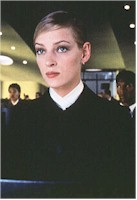 An increasing knowledge
about genetic constructs, combined with a fanatical drive for perfection in all things
underwritten in no small part by the influential social cohort known as the Boomers, not
to mention the eternal human fear of death, has led to an undercurrent that can best be
described as quietly hysterical. At times there seems to be only the faintest of moral and
ethical restraints standing in the way of those who believe in the theory that, just
because we can control the results of human reproduction pre-natally, we should,
regardless of the condition under review. In this sort of environment, the correction of a
fatal condition such as Tay-Sachs (if it were possible) can get lumped together with the
desire for taller offspring in the hands of the unscrupulous practitioner. As Gattaca
aptly demonstrates, it’s a short step from merely wanting more height to the removal
of less desirable personality traits, resulting in a race of emotional automotons. Mapping
the human genetic structure is a fine and noble calling, in theory, but in practice, and
without some effective safeguards in place, it could, and probably would, lead to just
such a society Unfortunately for the film, this obsession with perfection does not explain
precisely why Irene’s parents would not have corrected her heart condition, or how,
as the bearer of such a severe physical defect, she could be considered as part of the
elite. Granted, the weakness of Irene’s heart, twinned as it is with Vincent’s
condition, is a touching motif, but it is also somewhat inconsistent with the story
line’s requirements. In the overall scheme of things, it’s an easy error to
overlook, yet it is raised often enough in the course of the film to make total avoidance
difficult.
An increasing knowledge
about genetic constructs, combined with a fanatical drive for perfection in all things
underwritten in no small part by the influential social cohort known as the Boomers, not
to mention the eternal human fear of death, has led to an undercurrent that can best be
described as quietly hysterical. At times there seems to be only the faintest of moral and
ethical restraints standing in the way of those who believe in the theory that, just
because we can control the results of human reproduction pre-natally, we should,
regardless of the condition under review. In this sort of environment, the correction of a
fatal condition such as Tay-Sachs (if it were possible) can get lumped together with the
desire for taller offspring in the hands of the unscrupulous practitioner. As Gattaca
aptly demonstrates, it’s a short step from merely wanting more height to the removal
of less desirable personality traits, resulting in a race of emotional automotons. Mapping
the human genetic structure is a fine and noble calling, in theory, but in practice, and
without some effective safeguards in place, it could, and probably would, lead to just
such a society Unfortunately for the film, this obsession with perfection does not explain
precisely why Irene’s parents would not have corrected her heart condition, or how,
as the bearer of such a severe physical defect, she could be considered as part of the
elite. Granted, the weakness of Irene’s heart, twinned as it is with Vincent’s
condition, is a touching motif, but it is also somewhat inconsistent with the story
line’s requirements. In the overall scheme of things, it’s an easy error to
overlook, yet it is raised often enough in the course of the film to make total avoidance
difficult.
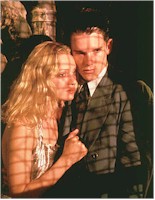 There are very few
special effects employed in Gattaca, which helps to convey the unease so inherent
in this situation. Niccol and company don’t attempt to overplay their design hand by
going for exotic, previously unknown, decors. Instead, and quite correctly, they stick to
the extremes of well-known modern style, with lots of stainless steel, slick, black
surfaces and some wood inlays with obvious Art-Deco leanings in the business and domestic
settings and reserve the neo-Classical look, festooned with touches of gilt-edged roccoco,
for those settings that are meant to be other-worldly and dedicated to fantasy, such as
nightclubs; think of the design format in Gattaca as the reversal of so-called
traditional decorating strategies. Nevertheless the thoughtfulness dedicated to the décor
is appropriate in a thematic sense: where else can fantasy take place in a regimented,
automated society but in public? The effect of this type of design strategy recalls other
science-fiction films with social concerns such as Metropolis, which had sets whose
details contained the exaggeration, but retained a then-contemporary (1927) look.
It’s difficult to look at the realistic, dystopian world depicted in Gattaca
and then to dismiss the film’s omnipresent, yet latent, fear of social repression in
the name of social engineering as mere paranoia.
There are very few
special effects employed in Gattaca, which helps to convey the unease so inherent
in this situation. Niccol and company don’t attempt to overplay their design hand by
going for exotic, previously unknown, decors. Instead, and quite correctly, they stick to
the extremes of well-known modern style, with lots of stainless steel, slick, black
surfaces and some wood inlays with obvious Art-Deco leanings in the business and domestic
settings and reserve the neo-Classical look, festooned with touches of gilt-edged roccoco,
for those settings that are meant to be other-worldly and dedicated to fantasy, such as
nightclubs; think of the design format in Gattaca as the reversal of so-called
traditional decorating strategies. Nevertheless the thoughtfulness dedicated to the décor
is appropriate in a thematic sense: where else can fantasy take place in a regimented,
automated society but in public? The effect of this type of design strategy recalls other
science-fiction films with social concerns such as Metropolis, which had sets whose
details contained the exaggeration, but retained a then-contemporary (1927) look.
It’s difficult to look at the realistic, dystopian world depicted in Gattaca
and then to dismiss the film’s omnipresent, yet latent, fear of social repression in
the name of social engineering as mere paranoia.
The performances in Gattaca also contribute to a sense of unease in the audience, since, in order to inspire sufficient levels of unease in the audience, the actors have to make the insane mentality of this world seem normal. As the star of the piece, Ethan Hawke is obliged to carry the picture’s credibility, which he does commendably. Ably assisted by Law and Thurman, Hawke deftly captures the ambiguity and ambition of Jerome/Vincent. His is a human ambition, with an American slant; only in America can you completely transcend your past. He is one of us and we can empathize with his desire to have and be something other than what was seemingly ordained by our origins. Thurman is both quietly eloquent and luminously beautiful; why would our hero ever want to pass up the chance to win her? Law, as the embittered ex-Superman, is a perfect foil to the genetically-challenged, ambitious Vincent. Gattacahas one of the best mixes of subtle social commentary and entertainment that has been seen in a Hollywood release in years, and it doesn’t need any of Huxley’s soma to give it plausibility.