
Snow-capped cedars swaying against an icy sky. Landscapes swallowed in white. Figures welling up from dense fog. Dead men, their faces and limbs protruding from the sandy beach where they've been washed ashore. Snow Falling on Cedars, the contemplative film that Scott Hicks, the director of Shine, has made from the popular David Guterson novel, comes closest to being the most black-and-white color movie in years, alternating from driftwood grays to the dark, dark browns of oil lantern smoke.
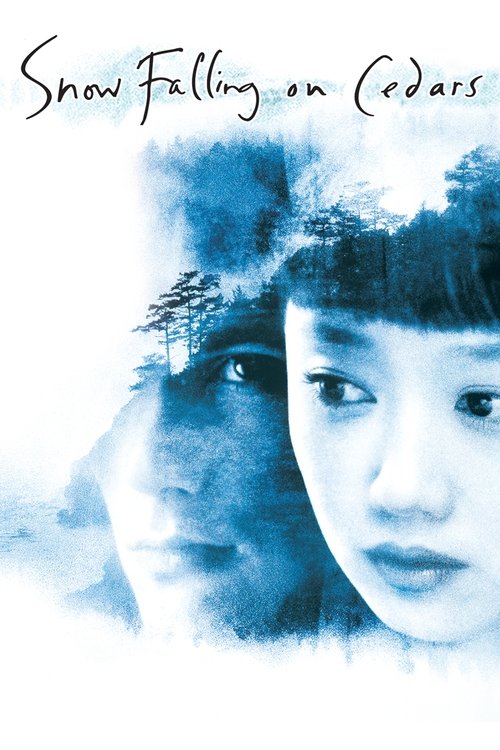
The images (photographed by Robert Richardson, who worked on several of Oliver Stone's films) are often gorgeous, though, and some of the acting is superb. Among the noteworthy: Richard Jenkins' tentative portrayal of a sheriff who lacks a sense of authority, trying to keep the peace while not making a disturbance or creating a mess. James Cromwell, as a courtroom judge, who makes himself known using very few words yet turns out to be immensely compassionate and sensible. Max von Sydow as a defense attorney, his face tired beyond comprehension, the skin sagging, puffy yet also looking like damp tissue paper that would disintegrate with one touch, yet still able to marshall his resources one more time since, being old and frail, he has become more intimate with matters involving death.
Hicks has chosen -- rather daringly, for a commercial film -- to make a film that is both a puzzle picture and a memory piece, with the characters' recollections weaving in and out of the narrative as the camera settles on each of them in turn. Only gradually do we learn all the story details. We know we are in a courtroom, at the trial of a Japanese-American (Rick Yune) accused of murdering a local fisherman, and that the action is set in the Forties, sometime after the bombing of Pearl Harbor. From the courtroom balcony, a young journalist (Ethan Hawke) takes notes on the proceedings while exchanging looks with the accused man's wife (Youki Kudoh, who, with her great, dark glassy eyes, stares right back at him, quivering). The journalist also comes across some evidence that could prove crucial to the trial, but he hesitates in bringing it forward. Why? We know that these two were in love with each other, and that circumstances tore them apart, but there seems to be something more of a reason than just simple jealousy. The truth is, eventually, revealed at the end of a rather stunning -- and actually rather crafty -- montage sequence that occurs about an hour and a half into the film.
Although there is a long, wordless sequence showing the rounding-up and relocation of the community's Japanese-American citizens to the Manzanar interment camp in California, Hicks appears more interested in the romantic conflicts in the story than in the racial situations that are actually at the heart of it. We never find out with any certainty whether the citizens who were forcefully removed, and who then returned to the town, are ever accepted back into the community to any degree. In any event, it doesn't change our reactions to the characters. The filmmakers have worked hard to make every frame of the film count for something, to add some new detail or some new layer of meaning to what has gone before, but there's a suspended, dangling feeling to the proceedings, and the film never really establishes a point-of-view. The picture as a whole feels slightly removed -- beautiful, muffled, but distant.
Ethan Hawke has never seemed like an actor who wanted to bare his soul to the audience. He has a broad-shouldered, more mature presence, here, than in previous films, and his sleek, handsome features are ruffled in a studious fashion by emotional undercurrents. But there is one moment, at a crucial point in the story, where his character suddenly expresses himself with such precise vehemence that it makes you wince. It's enough to make you think that Ethan Hawke just might make the transition into becoming an adult actor -- yet.